Superstition in The Tribe
Earth AbidesSuperstition in The Tribe is not simply a survival of old childish habits: it is a new tradition forming in the absence of the broad cultural inheritance that once helped people identify such habits as mere belief. The hammer on Ish’s mantelpiece and the children’s account of Americans as creators show how practical objects and fragments of history can acquire sacred force. Ish recognizes that he is not only observing this process but, through his authority and example, helping to produce it.
The hammer becomes a relic
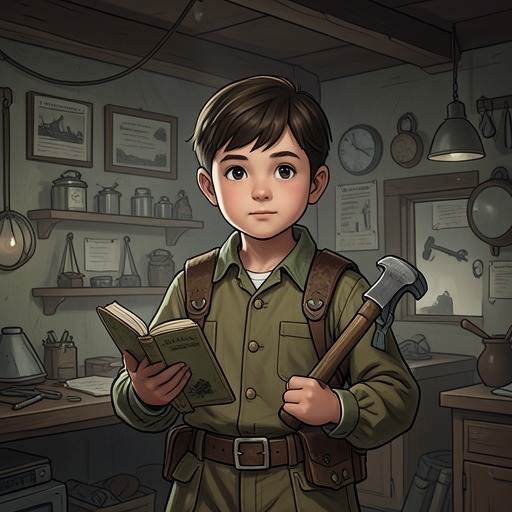
The realization begins in the classroom. Joey rose, crossed to the mantelpiece, and took Ish’s hammer while the other children watched in silence. One small girl gave a cry. Joey returned the hammer to Ish and sat down; only when Ish struck a nut with it did the tension ease. After dismissing school at noon, Ish understood the scene as superstition: the children associated the hammer with something strange and mystical from the distant past.
The object’s place in daily life had helped set it apart. The hammer stood alone on the mantelpiece and appeared on state occasions; ordinarily, nobody but Ish touched it. Even Bob had handled it reluctantly when the group set out with the dog-teams. To the children, Ish concluded, it had become an implement of power, dangerous for them to handle. Joey’s action made the difference especially visible: Ish wondered whether Joey, already distinguished by his reading, assumed that he shared something with his father and could touch what would harm the others. Ish did not treat this explanation as certain, but saw how a belief might gather around the boy as well as the tool.
A tradition interrupted
The hammer was only one sign. Ish remembered children singing the rhyme about stepping on a crack and breaking their mother’s back. In the world before the Disaster, he had heard it as an ordinary bit of childhood; growing children learned that such things were not literally true. In The Tribe, he could no longer assume that a wider culture would correct the children’s beliefs as they grew up. Ezra’s Victorian penny, carried as a pocket-piece, and Molly’s habit of knocking on wood also came to mind. Ish remembered children doing the same, and worried that they might not learn to distinguish comforting custom from a force that actually changed events.
He saw the community’s thin inheritance as both possibility and danger. The small group had lost much of its tradition because seven survivors could not preserve and transmit all that had come before, and because for a long time there had been no older children to pass customs on to younger ones. The oldest children had learned games from their parents rather than from older companions. Ish thought this left the community unusually open to new ideas, but also vulnerable: a demagogue, he feared, might exploit that openness. Reading had not made the children readily receptive to instruction either; he suspected that their environment was already exerting a stronger influence.
Against this diminished inheritance, Ish set the much larger store of customs and beliefs once available through Christianity, Western civilization, Indo-European folkways, and Anglo-American culture. Those traditions had shaped individuals by surrounding them with ways of understanding the world. Their absence did not leave the children free of belief. Instead, it left them with fewer shared means of testing and revising what they believed.
The authority Ish cannot simply use
Ish considered whether the children’s supernatural beliefs reflected a vacuum: perhaps, he thought, their minds were reaching for an explanation of life itself. The community had once organized church services and later discontinued them as meaningless; he now wondered whether abandoning them had been a mistake. More certainly, he recognized that he could become the founder of a religion for a whole people. What he taught the children at school might be retained through insistence and repetition, whether he offered a religious account of creation, a local Indian legend, or one of several theories he remembered from his studies.
That power troubled him because he could not honestly present an explanation merely because the children would accept it. He imagined the consequences of leaving the community’s need for belief unaddressed: later generations might develop incantations, fear witchcraft, or treat practices such as taboo as unquestionable. These were Ish’s fears about a possible future, not events the narrative says had already occurred. Yet he knew that taboo-like beliefs were already present—and that he had inadvertently helped establish them. The restriction surrounding Evie was one example: Ish, Em, and Ezra had made her effectively untouchable to the boys because they did not want her to have children who would require care. A measure devised for a practical reason had taken on the shape of a social prohibition.
The Americans as makers of the world
Ish tested the children’s ideas by asking how the world had been made. Weston spoke for the group: the Americans had made everything. Ish immediately understood how that story could have arisen. When children asked who made houses, streets, or canned food, older people naturally answered that the Americans had done it. The community had turned the makers of the familiar built world into creators on a far larger scale.
Ish tried to correct the inference by explaining that he was an American and that Americans had been ordinary people. The clarification failed in the opposite direction from the one he intended. The children treated Ish’s knowledge of reading, writing, the shape of the world, and numbers, along with the hammer he carried, as evidence that he belonged to the exceptional people who had made everything. He was not, in their understanding, a counterexample to the legend, but one of the Old People left behind. Joey’s smile suggested that he, too, felt connected to this past: he could read and carry the hammer without being hurt. Ish ended the lesson, unable to find a reply that would dislodge the belief.
Belief and reproducible knowledge
The episode contrasts the symbolic force of inherited objects with Ish’s effort to pass on knowledge children could reproduce for themselves. In making a bow, he rejected the option of braiding nylon fishing line because it was not something the children could always obtain. Instead, he shaped a lemon shoot and made a heavy bowstring by shaving and braiding strips of rawhide from a recently killed calf. His choice made the method depend on available materials and teachable work, not on the possession of a scarce relic.
The children’s response gave that teaching a different kind of momentum: before dinner, every child in The Tribe was whittling a bow of their own. The scene does not establish that practical instruction displaced superstition. Rather, it sets two forms of cultural transmission beside one another: a hammer made powerful through distance, repetition, and reverence, and a skill that could spread through demonstration and imitation. Ish’s predicament is that he wants to preserve knowledge without turning his own authority into another unquestioned tradition. In The Tribe, the past is not merely lost; it is continually remade from whatever objects, stories, and practices remain.